
Shelly Presence Gen4: $84.99 mmWave With 10 Zones, and Some Numbers That Don't Match
Shelly's mmWave presence sensor brings 10 zones, Matter or Zigbee, MQTT and scripting for $84.99. Its own spec pages disagree on coverage and how many people it tracks.
Shelly Presence Gen4: $84.99 mmWave With 10 Zones, and Some Numbers That Don't Match
Shelly launched the Presence Gen4 in North America on October 15. It's a USB-C-powered mmWave radar presence sensor, it's $84.99 at Shelly's U.S. store, and Shelly's press release says Micro Center, Best Buy, Newegg and Amazon are coming soon. The pitch: up to 10 people tracked across up to 10 zones, no camera, and Wi-Fi, Bluetooth, Zigbee and Matter in one box.
I read through Shelly's documentation page line by line, because that's where presence sensors live or die. It's a good-looking spec sheet, with a few places where Shelly's own numbers disagree with each other and with the launch coverage.
Why mmWave instead of a motion sensor
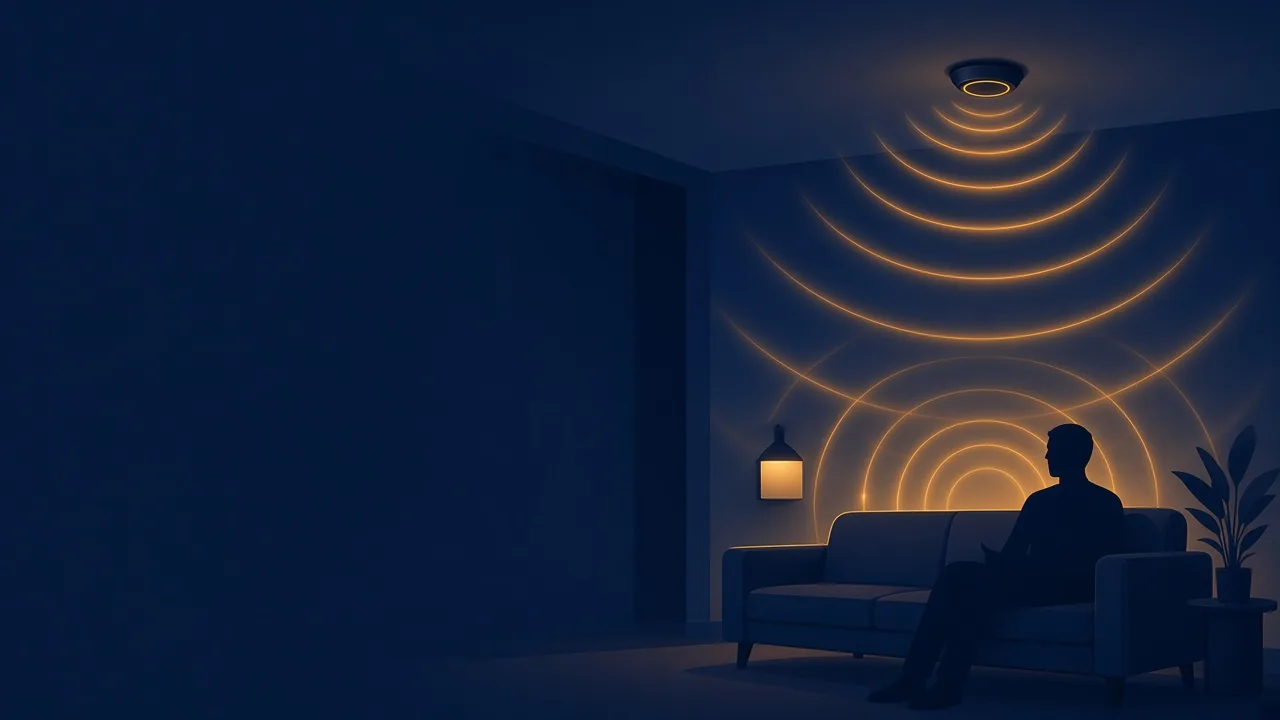
A PIR motion sensor sees movement. Sit still at a desk long enough and the lights go off. mmWave radar picks up the tiny movements of someone sitting or lying still, which is the whole reason to pay more for one. Shelly's spec table lists still detection "up to 3 m," about 10 feet. That's the number I'd plan around: put the sensor within 3 meters of the chair or sofa you care about.
What you get
- Radar: 60-64 GHz, 140 degrees horizontal and 120 degrees vertical on a wall, 90 degrees in a corner.
- Tracking: up to 10 people and up to 10 zones (but see below), with a live occupancy map of where people are.
- Filtering: minimum and maximum height settings, so you can ignore pets and robot vacuums or deliberately include them. Presets, plus adjustable transmit power and sensitivity.
- Light sensor: reports dark, twilight or bright. Three steps, not a lux value.
- Radios: Wi-Fi 6, Bluetooth 5 LE, Zigbee 3.0, and Matter over Wi-Fi. Shelly doesn't list Thread.
- Local stuff: built-in web interface, scripting, MQTT, 20 webhooks with 5 URLs each, and 20 schedules.
- Power: 5 V USB-C at 1 A, 2.5 W nominal and 3.5 W max.
- Size: 64 x 41 x 26 mm bare, 73 x 41 x 37 mm on its weighted stand. White or black. Three-year warranty.
The numbers that don't agree
Coverage. Shelly's press release, The Verge and Matter Alpha all say up to 650 square feet on a wall and 525 in a corner. Shelly's U.S. product page says "covering an area up to 450 sqft." The docs say "up to 42 m²," which is about 452 square feet. The same docs' spec table gives an 8 x 8 m wall-mount area (about 690 square feet) and 7 x 7 m in a corner (about 527). So depending on which line you read, the wall-mount figure runs from roughly 450 to 690 square feet. I'd plan on the smaller one.
People. Shelly's marketing and feature list say up to 10 people at once. The radar section of the spec table says "Object detection: Yes, up to 6 objects (people)." Maybe that's a stale line, or maybe it's a firmware limit that has since changed. Shelly should fix one or the other. If you're buying this to count people in a family room, it matters.
Neither one is a dealbreaker for a desk, a reading chair or a single bedroom. Both matter if you were hoping to cover an open-plan kitchen and living room with one sensor.
Matter or Zigbee: pick one
The button behavior in the docs tells you something the box doesn't. The sensor ships running Matter firmware. Pressing the button five times "switches the device from Matter firmware (default) to Zigbee, or back." My read is that you choose a mode: Matter over Wi-Fi, or Zigbee. Not both at once.
The Matter side has a catch of its own. Per Shelly, a Matter controller sees only one room zone by default. You can add zones up to the maximum of ten, and each new zone shows up as a separate component. Shelly points to its Smart Control app and web interface guides for enabling Matter and adding zones.
The cloud integrations expose even less. Shelly lists the supported capabilities as Motion Sensor for Alexa, Occupancy Sensing for Google, and Presence Sensor for SmartThings. So through Alexa, the most expensive part of this sensor, the per-person tracking, turns into a motion trigger. If radar presence drives that trigger, it should still beat a PIR sensor that gives up when you sit still. But the zone map and person tracking stay in Shelly's own tools.
Home Assistant
Shelly says it integrates with Home Assistant, and you have options: Matter, Zigbee (in Zigbee mode), Home Assistant's Shelly integration over Wi-Fi, or MQTT straight from the device. What I couldn't confirm is which entities Home Assistant's native Shelly integration creates for this model, such as per-zone occupancy, target counts or the light level. ZHA or Zigbee2MQTT support for it is also unconfirmed. If you live in Home Assistant, MQTT plus on-device scripting is the path I'd expect to give you the most control, and it doesn't depend on anyone shipping an integration update.
Two install details worth reading twice
The power warning. Shelly's docs carry an all-caps "ATTENTION" note: use a dedicated, high-quality 5 V adapter, and avoid multi-port chargers, charging stations and fast-charging adapters whose output can fluctuate, because that "may damage the device." So don't plug it into the spare port on a USB hub behind the TV. Give it its own brick.
Placement. Shelly recommends mounting at about 2 m (6.5 feet) with roughly a 15-degree downward tilt, centered on a wall for the full 140 degrees. It supports rooms up to 5 m tall and up to 8 x 8 m. It can't see through walls or behind itself, and you tell the app where you mounted it so it can adjust. If you mount it upside down there's a "flipped mounting" setting, and Shelly links a printable corner bracket on Thingiverse.
Is it worth $84.99?
For a Matter or Home Assistant user who wants one room done well (office, den, bedroom), yes, it looks like a reasonable buy. Still detection, height filtering to keep the robot vacuum from turning on the lights, a light sensor, and local control with MQTT and scripting is a lot for the price. The local control is the reason I'd look at Shelly in the first place.
Before you order, decide whether you want Matter or Zigbee, and plan for about 450 square feet until someone measures it properly. If you're on Alexa or Google and only want "lights on when someone's in the room," you'll be paying for zone tracking those platforms don't show you. The six-versus-ten people question is one I'd want Shelly to answer before buying it for a busy shared room.
Permalink: https://homeautomationweekly.com/issues/8-shelly-presence-gen4-mmwave-sensor